
Interested in CURO?
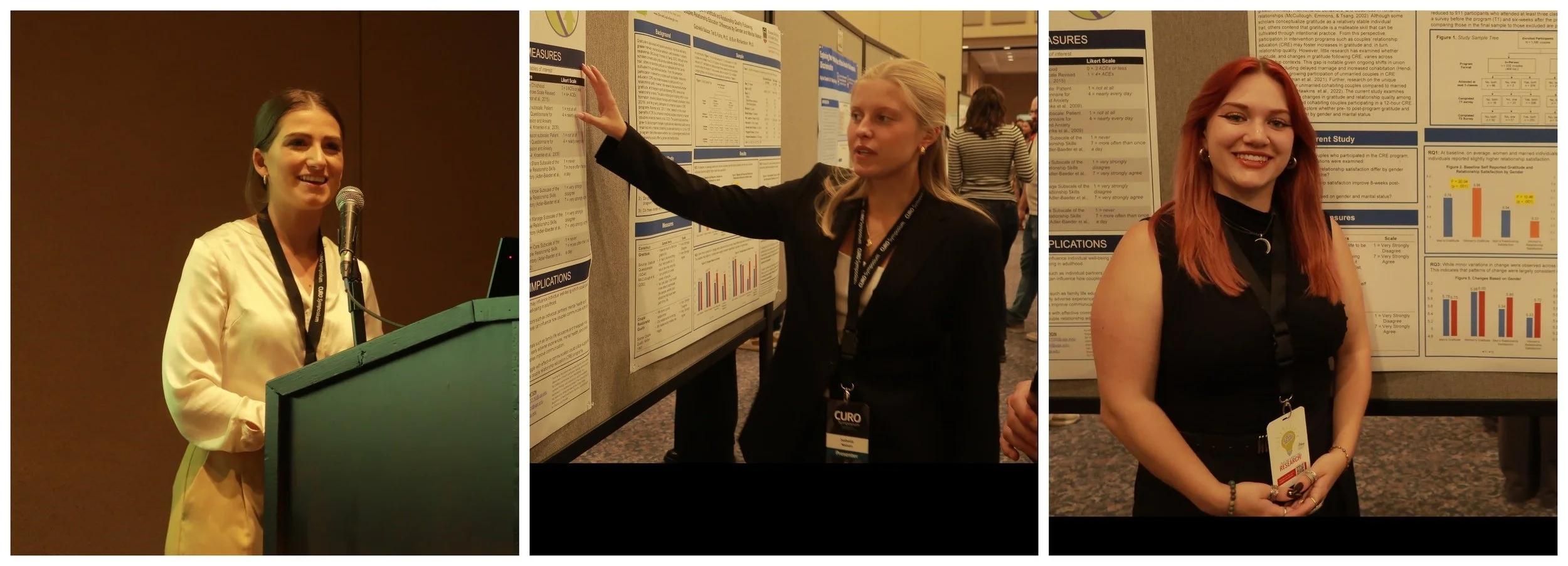
Many CARE Lab students pursue independent research through UGA's Center for Undergraduate Research Opportunities (CURO). Students work closely with faculty mentors to develop and conduct research projects that align with their interests and career goals.
Center for Undergraduate Research Opportunities (CURO) in the CARE Lab are open to all undergraduate students pursuing faculty-mentored research and who have completed at least one semester as a volunteer/intern in the lab.
CARE Lab students have completed CURO projects on topics including ADHD and couple relationships, gratitude, loneliness, coparenting, relationship education, financial stress, and adolescent relationships. Many projects have resulted in conference presentations, honors theses, and co-authored publications.
Former CURO Students and Projects:
Rebecca Kann, Psychology (Class of 2026). Project: The relationship quality of couples with ADHD.
Gaberiella Salazar, HDFS (Class of 2026). Project: Gratitude and relationship quality following couples relationship education.
Isabella Nelson, Psychology (Class of 2026). Project: Adverse childhood experiences, adult relational risk, and couple relationship quality.
Lydia Shepherd, HDFS (Class of 2025). Project: Loneliness in the context of couple relationships.
Meghan Wolsifer, Biology (Class of 2025). Project: The association between mental health and couples’ perceived experiences in relationship education.
Abigail Scott Gilbert, Psychology (Class of 2024). Project: The Impact of COVID-19 on couple relationships before and following relationship education.
Yali Phillipson, Psychology (Class of 2023). Project: Reducing adolescent risky sexual behaviors through relationship education.
Annabelle Armah, HDFS & Psychology (Class of 2021). Project: Changes in coparenting quality following the Together We Can Program: The moderating effects of race and maternal distress.
Sol Moreno, Psychology (Class of 2020). Project: Variations in relationship quality for Latino versus non-Latino couples following relationship education
Taylor Hawley, Psychology (Class of 2020). Project: Relationship quality following a couples’ relationship enrichment program: Variations based on marital and stepfamily status.
Sara Dean, Psychology (Class of 2020). Project: Changes in unmarried mothers’ mindfulness, parenting stress, and co-parenting relationship following the Together We Can program
Hayley Cohen, Psychology (Class of 2020). Project: Changes in financial distress and relationship quality following a couple relationship and financial literacy program.
Rachel Nagey, Psychology (Class of 2019). Project: Variations in coparenting and parenting functioning among at-risk couples following participation in couples relationship education.
Monica Han, HDFS (Class of 2018). Project: The association between program fidelity and impact: How facilitator engagement and program adherence influence couples following relationship education.
Angela Hendricks, HDFS (Class of 2016). Project:The efficacy of relationship education on middle school aged adolescents
Avery Campbell, HDFS (Class of 2016). Project:The influence of formal and informal sources of support on foster parents' couple and co-parenting relationship quality.
Lauren Head, Biology and Psychology (Class of 2014). Project: Differences between cohabiting and Nnn-cohabiting couples who participated in premarital education.
Helen Moser, HDFS (Class of 2012). Supported training and technical assistance efforts of state-funded teen pregnancy prevention program.
Interested in Conducting Research?
The student projects highlighted above represent just a few of the many undergraduate research opportunities available through the CARE Lab. If you are interested in gaining research experience, working alongside faculty mentors, or developing your own research project, we would love to help you get started!
Visit our Undergraduate Students page to learn more about available opportunities, expectations, application deadlines, and how to apply.
Questions? Email Dr. Ted Futris (tfutris@uga.edu) and Dr. Evin Richardson (evinr@uga.edu).